
Persistent Endometritis Linked to Worse FET Outcomes
09/03/2026
Key Takeaways
- In a cohort of 2,885 women at Henan Provincial People’s Hospital in China who underwent subsequent frozen-thawed embryo transfer after first implantation failure, chronic endometritis defined as ≥5 CD138-positive plasma cells/HPF was identified in 16.8%.
- Among women who initially met that threshold, histological remission after one or two empirical antibiotic courses was achieved in 433 of 486 women (89.1%).
- Women whose post-treatment biopsies fell to 4 or fewer CD138-positive plasma cells/HPF had subsequent pregnancy outcomes comparable to those of women already in the 4-or-fewer group.
- Persistent chronic endometritis was associated with lower clinical pregnancy and live birth rates than the 4-or-fewer-cells/HPF group.
- In women with 1-4 CD138-positive plasma cells/HPF, antibiotic exposure was not associated with improved reproductive outcomes.
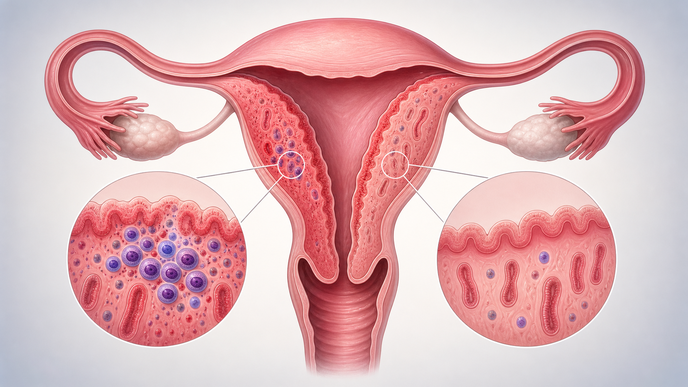
In a retrospective cohort study of chronic endometritis after first implantation failure, women with first implantation failure after in vitro fertilization/intracytoplasmic sperm injection (IVF/ICSI) who later underwent frozen-thawed embryo transfer (FET) within six months were evaluated. Of 4,528 women screened, 2,885 were included. First implantation failure meant that the first embryo transfer cycle did not achieve pregnancy despite transfer of at least one morphologically high-quality embryo, with negative serum beta-human chorionic gonadotropin 14 days after transfer. All participants underwent routine hysteroscopy-guided endometrial biopsy with CD138 immunohistochemistry; chronic endometritis was defined as at least 5 CD138-positive plasma cells per high-power field (HPF), and remission on repeat biopsy meant fewer than 5 cells per HPF, equivalent to 4 or fewer. Women meeting the threshold received empirical doxycycline first, then levofloxacin plus metronidazole for persistent disease, followed by repeat Pipelle biopsy before FET. The primary outcome was live birth, with clinical pregnancy and early miscarriage as secondary outcomes; multivariable adjustment and inverse probability of treatment weighting (IPTW) were used to test the association.
Chronic endometritis was present in 16.8% of the cohort, and overall histological remission after one or two antibiotic courses reached 89.1% among women with initial chronic endometritis. Persistent disease was associated with lower clinical pregnancy and live birth rates than the 4-or-fewer-cells/HPF group, at 39.6% versus 56.6% and 28.3% versus 41.8%, respectively. Multivariable adjustment also linked persistent chronic endometritis with lower odds of clinical pregnancy and live birth. In the IPTW analysis, the lower clinical pregnancy rate remained significant with OR 0.65 (95% CI 0.47-0.89; P=0.008), while the live birth association was directionally similar but borderline at OR 0.73 (95% CI 0.53-1.02; P=0.056). Women whose biopsies normalized had outcomes comparable to those of the 4-or-fewer group, and antibiotic exposure in the 1-4-cells/HPF subgroup was not associated with improved outcomes.
The retrospective single-center design leaves room for residual confounding, and the pathway reflects one Chinese center’s routine practice rather than a standardized approach across regions, so applicability to U.S. fertility programs is uncertain. Because all women meeting the chronic endometritis threshold were treated, the pattern after remission cannot show that antibiotics caused the subsequent outcomes. Interpretation is also limited by the relatively small persistent-disease subgroup, individualized antibiotic use in the 1-4-cells/HPF subgroup, the change from hysteroscopic forceps biopsy to repeat Pipelle sampling, and the lack of systematic microbiologic or virologic characterization.
The authors interpreted the findings to mean that counts of 4 or fewer CD138-positive plasma cells per high-power field were not linked to worse next-cycle pregnancy outcomes in this cohort. Women whose biopsies normalized had outcomes similar to those of the 4-or-fewer group, whereas persistent chronic endometritis identified a subgroup with poorer subsequent frozen transfer outcomes.
Clinician Questions
How was chronic endometritis defined after first implantation failure in this cohort?
Chronic endometritis meant at least 5 CD138-positive plasma cells per high-power field in the endometrial stroma on hysteroscopy-guided biopsy, while post-treatment remission meant fewer than 5 cells per high-power field, equivalent to 4 or fewer, on repeat Pipelle biopsy before frozen-thawed embryo transfer.
Which patients were included in the subsequent frozen embryo transfer analysis after first implantation failure?
The analysis included women younger than 41 years who had first implantation failure after IVF/ICSI with at least one morphologically high-quality embryo transferred, underwent routine post-failure hysteroscopy-guided biopsy with CD138 staining, and completed a subsequent frozen-thawed embryo transfer within six months; women with major uterine pathology, hydrosalpinx, chromosomal abnormalities, primary ovarian insufficiency, immune-related disease, or ultrasound-identified endometriosis or adenomyosis were excluded.
What antibiotic and reassessment pathway was used for chronic endometritis after first implantation failure?
Women who met the chronic endometritis threshold received doxycycline 100 mg twice daily for 14 days, those with persistent at least 5 CD138-positive plasma cells per high-power field then received levofloxacin 200 mg twice daily plus metronidazole 500 mg three times daily for 14 days, and post-treatment status was reassessed with repeat Pipelle biopsy before the next frozen-thawed embryo transfer.