
Longitudinal Mammographic Deep Learning Risk Scores Track Future Cancer
06/29/2026
Key Takeaways
- Scores increased over time before breast cancer diagnosis and remained comparatively stable in women who stayed cancer free.
- The modeled yearly increase was steeper in the cancer group, and the same overall pattern appeared across age and breast density subgroups.
- The authors described repeated image-only mammographic scores as potential dynamic biomarkers rather than fixed risk estimates.
The retrospective multicenter cohort included women screened between January 2, 2009, and December 31, 2019, at six imaging sites within one large academic health system. In the Radiology study, the final cohort comprised 54,014 women and 158,807 screening mammograms, including 817 women with breast cancer or ductal carcinoma in situ within 365 days of the index examination and 53,197 cancer-free controls. A validated image-only Mirai model generated continuous 5-year breast cancer risk scores from screening mammograms. Linear mixed-effects models with random intercepts and slopes were used to evaluate repeated examinations, and the cohort had a median age of 61 years with a median of three mammograms per woman.
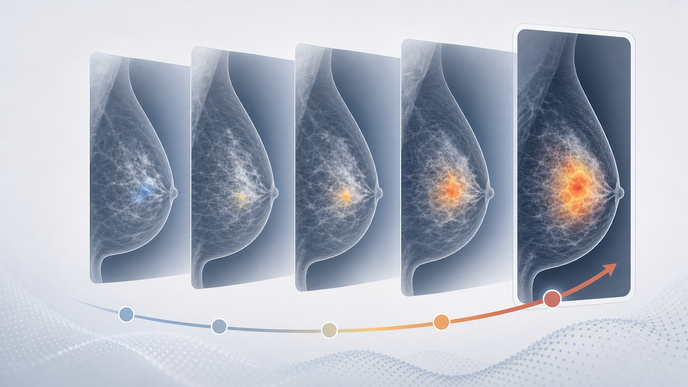
Modeled trajectories diverged clearly between groups over time. The yearly slope was 1.13 in the cancer group and 0.09 in cancer-free controls, yielding a difference of 1.04 per year; the corresponding 95% confidence intervals were 1.07 to 1.18, 0.08 to 0.10, and 0.99 to 1.09, respectively, with P values below .001. As a descriptive illustration, median scores in women later diagnosed with cancer rose from 2.1 six years before diagnosis to 6.6 at the index examination. In controls, median scores ranged from 1.8 to 2.2 across the same period. Scores were also higher at each yearly interval before diagnosis.
The overall trajectory pattern remained consistent after age adjustment and across breast density and age strata. Subgroup analyses showed the same directional separation in women with dense and non-dense breasts and in age groups younger than 50, 50 to 59, 60 to 69, and at least 70 years. The authors interpreted the repeated image-only scores as behaving more like dynamic imaging biomarkers than fixed risk estimates. They also described longitudinal scoring as a possible marker for future study in clinical decision-making.
The authors noted several constraints on interpretation. The cohort came from a single health care system using Hologic mammography systems, some women may have contributed remote examinations to the model training dataset, and the analysis repeatedly applied a validated single-examination model rather than a separately developed dynamic model. The study also did not assess static detection performance, did not examine whether high index-examination scores aid early cancer detection, and did not include a formal sample size or power calculation.
These findings reflect an observed association between longitudinal score change and later breast cancer diagnosis within this dataset, not a tested action threshold or prospective clinical use.